Empathy by Teachers for Working Parents

Below is an anecdote I wrote as an example for a writing assignment for my middle school students.  I thought it would be prudent to share with fellow teachers.  We need to practice empathy for the  parents of our students, as well as for our students.  Teachers are guides to help and serve, not to judge.

“As a teacher, I often spend more time with people’s children than they do.  I get to know them as family, and think of my students as my own children.  As adults, we often have multiple jobs, multiple hats to wear:  parent, spouse, sibling, child, co-worker, and so forth.  When you work and have children, it is difficult to juggle those hats.  As a Montessori teacher, we are trained to observe closely the students in our care and supply not only academic care, but also social and emotional nurturing.  I get upset when I see children neglected in small ways.  However, as I grow as a mother and a teacher, I increasingly put myself in others’ shoes.

Very early in my career, I taught a young boy who would come to school in dirty clothes, wrinkled like an old newspaper and covered in bright green grass stains and flecks of playground mulch.  His hair looked like messy strands of bleached straw upon his head.  On cold winter days with crisp biting winds, he would come in simple shorts and a thread-bare t-shirt, without even a coat.  I felt so badly as he shivered like a lamb, and I offered him my own coat, which swamped his small body like a blanket.  As I look back on the situation, I should have handled it better than I did.

As a young teacher, I didn’t feel comfortable offering advice to a parent.  But now, I am older and more comfortable talking to and offering advice to parents.  I have more experience under my belt as a parent and a teacher.  I know how I would want to be helped as a busy, working mom.  Perhaps I should have given a gentle reminder about the cold weather at carpool, along with having a back-up supply of old coats and pants from my boys to clothe this young boy.  Those simple hints to the mom without judging, and helping the young student without singling him out, would have been better than just talking about it, remembering only the negative experience.  I should use this story as a reminder of how to treat others, as I would wish to be treated.”
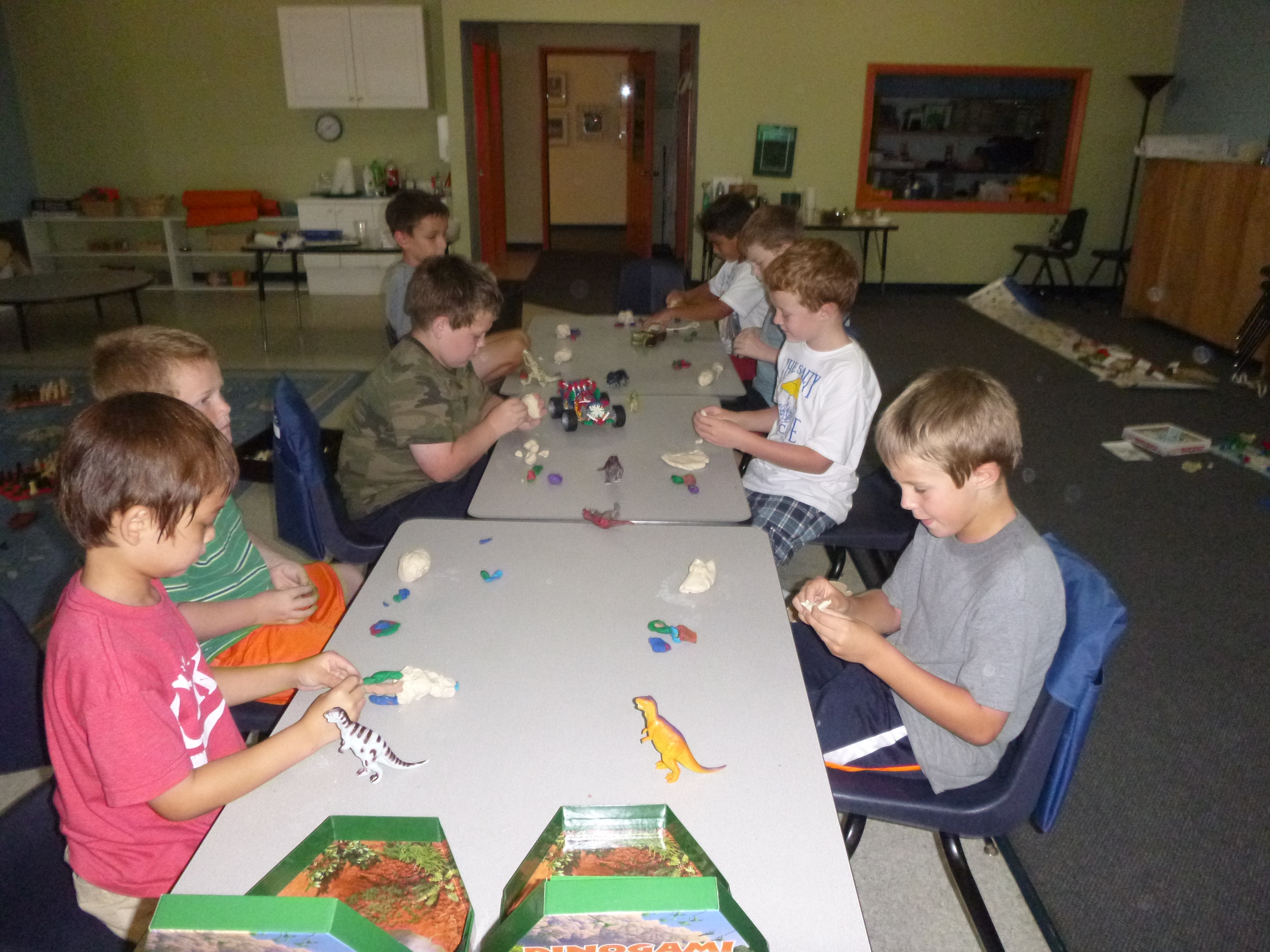
P1000237

First Week of School: Building Community

In Montessori middle school programs, it is vital to start the year with community building lessons and activities.

“To learn, children and adolescents need to feel safe and supported.” –  William H. Parrett and Kathleen M. Budge

We begin every morning with a fun game to get the students relaxed and energized before academic lessons.  These include name recognition, charades, sports-related/coordination building, and trust-building activities.

Then, we have morning meeting daily.  Each week, a different student facilitates the meeting with a set agenda that includes sharing, acknowledgements, mental challenges, PACE (Brain Gym), and announcements.  The regularity and positive sharing aspects allow the students to communicate in a respectful way and wake up their brains and bodies for learning.

During academic work times, all subject areas involve individual, small group, and large group assignments.  This way, introverted children have some personal time to complete assignments suited to their personality, and extroverted children get their group discussion needs met.  In between, small group work allows children to build leadership and cooperation skills.  Middle school children especially desire more social interaction and learn better from peers than teachers. (see article here)

At Sea Pines Montessori Academy, we are off on the right foot with our class of 2014-2015.  These wonderful young men and women are going to do great things…

–Sarah

Making Lemonade: Remaking Your Classroom Space

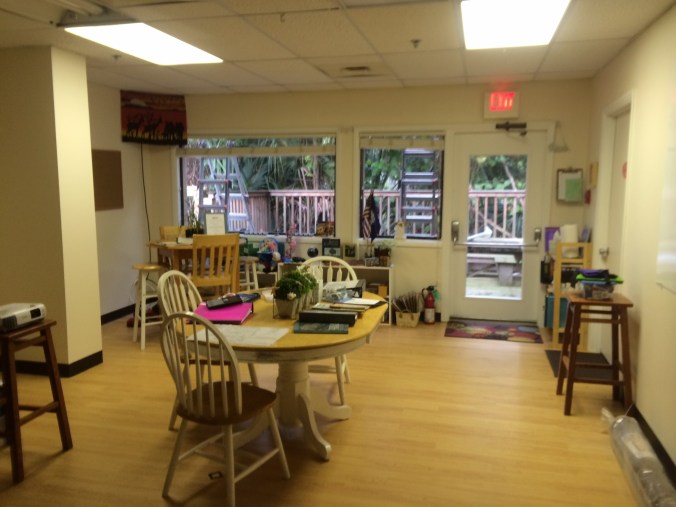
With our growing lower school, my middle school program had to move from one large classroom into two smaller spaces at the opposite end of the school.  A larger pre-school program means more children for our upper school.  But, as any teacher will tell you, moving your entire classroom and its contents is no easy task.

On top of that, I had to put two years of curriculum for every subject I teach (language arts; history – world, American, South Carolina; math – Pre-Algebra, Algebra 1 and 2, Geometry; Chinese; science – physical and biological, and practical life) somewhere in that space.  All while leaving room for eight teenagers to move around.  Phew!

My motto became when life hands you some nice lemons, make lemonade!  I re-imagined the space, and with some help from friends, the local thrift shops, and creativity, succeeded in creating a welcoming environment.

The video below is a slide-show of my classroom and its contents.  As a Montessori Middle School teacher, I am a generalist.  I have a cultural area for history and science.  My language arts and math books are in another room where we have created a library and work space.  This year, we are focusing on biological science and using the Estuary 101 curriculum I received from the South Carolina Department of Natural Resources (see my week-long post from the Salt Marsh STEAM experiences).

I maximized floor space with three small tables, and kept the wood as light as possible to make the space seem larger.  I used natural wood and table decorations to infuse the classroom with vitality and nature.  I kept familiar items (student mementos) so that they would have a continuum from the old space.  I added some inspirational messages for the front door so the teens would feel hopeful as they walked into the room.

Overall, I am pleased with the outcome.  The students and parents who visited last week enjoyed it too.  I look forward to the exciting things we will be doing as we study our beautiful island ecosystem and study global peace through our Model United Nations projects.

Peace, Sarah

Salt Marsh STEAM 2014 Day 5: Inspiring Project Presentations


We have come to the end of the Salt Marsh STEAM program with South Carolina’s Department of Natural Resources, Salt Marsh Consortium, Sea Grant, NOAA, Bobino (did I leave anyone out?).  E.V. Bell and her co-workers put together an amazing week of learning, fun, community, and swag.  Thank you all!

Today, each participating teacher presented his/her proposal for a project based on the Estuaries 101 curriculum and activities that we learned this week involving science, technology, engineering, art, and math (STEAM).  I learned so many different, creative approaches to educating children about these ecosystems.

We had edible marshlands, iMovies, Bobinos (Arduino-based buoys), watercolors, poems and more.  An English teacher teaching literature archetypes created a project where students would research animals and plants in the estuary and match that fauna or flora to a certain literary archetype.  Students would then compose an origin myth about that particular organism and archetype.  Another is having her students build a Bobino from PVC tubing and connectors and then monitor weather and water quality around Hilton Head Island.

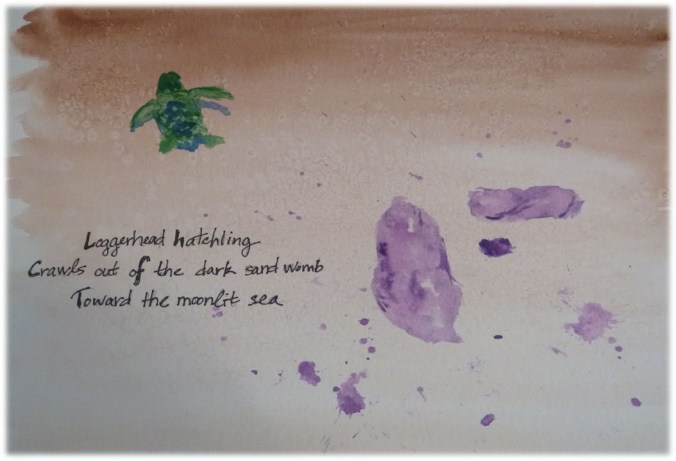
I will be using the Estuaries 101 curriculum to teach biology units all throughout this year.  My particular presentation is on a poetry anthology that the students will complete based on the flora and fauna of the ACE basin and Hilton Head.  The theme for the six-week cycle is systems, where we will study economies, systems of equations in algebra, ecosystems, and “systematic” poetry.  Students will write a haiku, Shakespearean sonnet, ode, and sestina; all of these poetry types require the writer to use certain rules for topic, syllable count, meter, rhyme, and word count.

Then, students will create watercolors, photographs, or movies to illustrate their poetry.  Finally, the teens will be required to write an essay where they explain their choice of topic and how that poetic structure fits with their topic.  The anthologies will be compiled with cover page and presented.

I have enclosed a video slideshow to display my examples and SC state standards met by this activity.

Thank you STEAM friends.  I had a lot of fun.  Remember, Neptune’s Nest foreva!

–Sarah


Salt Marsh STEAM 2014 Day 4: Geekin’ Out!

Today was a TOTAL blast.  We got to find our inner geek (or use our outer one) and engineer buoys. Buoys play an important role in monitoring the environment and providing data to find trends in ecosystems.

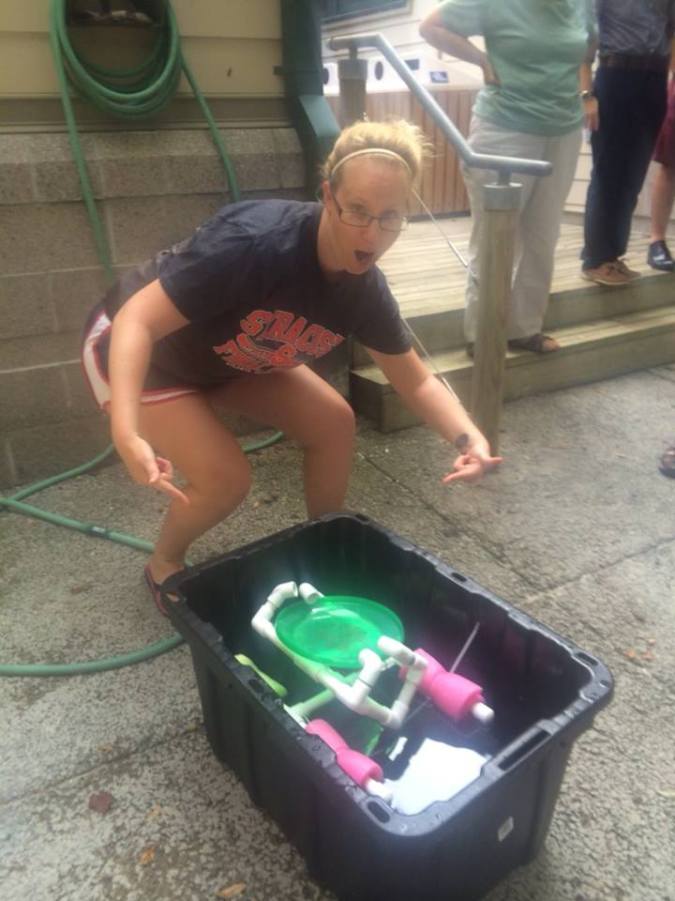
The instructors proved a great maker space of different sizes of PVC pipe and connectors along with swimming noodles.  Our goal was to create a buoy that would float upright and keep a frisbee still to prop up an Arduino board.  The Arduino board contained sensors to measure air temperature, ambient light, barometric pressure, and humidity.

Once we tested the buoy for buoyancy, we added the Arduino weather monitor.  Our “eBOB” or “Bobino” collected data every minute for 30 minutes.  Some groups kept their eBobs inside, while others placed theirs outside.

Then, we analyzed the data using the information stored on the enclosed SD card.  WOW!  Using Excel, we graphed the data and saw neat patterns:  a rise in temperature once the unit was placed outside, correlating with a rise in ambient light.

The gentlemen who provided the equipment, free of charge to us teachers, were part of the North Carolina School of Technology.  Taylor Brockman, Chief Technology Officer at Brain Power Software, helped two young men create the Arduino boards.  These young men, Benson and Maxwell, were polite, intelligent, and inspiring.  (I asked for the leader’s business card to seek out opportunities for my son.)

Jen, my partner in crime, and I had so much fun and were proud to be first to finish our sea turtle inspired buoy.  Peace out!

–Sarah


Salt Marsh STEAM Day 3: Watercolor 101: Marie Nichols is amazing!

I had a two-hour workshop today on sketching and watercolor techniques with Marie Nichols, an instructor at Charleston School of the Arts.  She is an amazing lady with a kind, gentle approach to visual arts.

We started with blind contour drawings of shells and hands.  Let’s just say, my drawings were pretty messed up!  Then, we worked our way to a modified contour drawing where we could take peaks at our paper to follow the prominent lines in the object as we drew.  Finally, we concluded our drawing study with adding value to the modified contour drawing.  Hatching and cross-hatching, with shading added texture, shadows, and depth to our shells.

After our sketching lessons, we learned watercolor techniques.  Starting with a flat wash, we used a broad brush dipped in rather concentrated dark color and brushed it straight across the page.  We repeated these steps, covering our 140 lb. watercolor paper in one, even hue.

We contrasted the flat wash with a graded wash, where you dip the brush only once in the concentrated, dark pigment (in our example), and then brush across the top of the paper.  Then, we washed the brush the clean, dabbed in water and ran the brush partly across the dark brushstroke at the top to get a lighter value.  After each stroke, we dabbed our brush in water and voila, we had a graded background on our paper.

Other techniques included the use of salt, plastic wrap, and lifting to get different textures on the background wash.  We used drops of alcohol to achieve beautiful, round lighter spots on the paper.  Another technique involved wetting the paper first, then applying watercolor on vertical paper to get interesting secondary and tertiary colors from primary hues.  Finally, we splattered paint on the surface, then used a straw to get streaks.

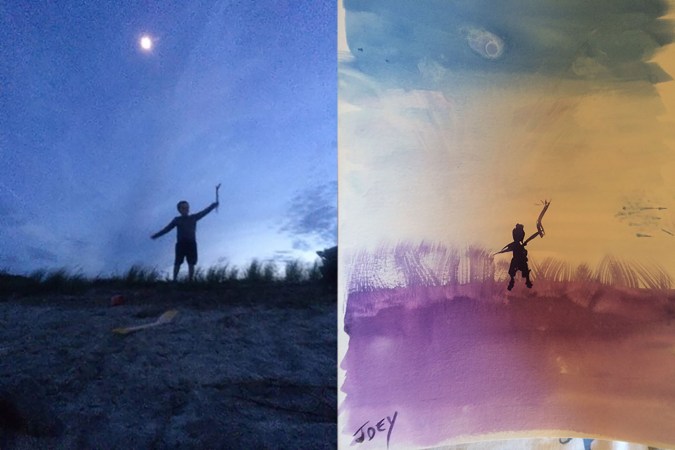
After all of that work, we composed quick pieces of nature scenes using all of our new-found knowledge.  You see mine at the top…an ode to my youngest son, Joey.

–Sarah

Salt Marsh STEAM 2014 Day 2: Saving a Life

Words cannot express what we did today at Botany Bay beach, on Edisto Island.  I have always seen sea turtle nests on Hilton Head Island, marked by wooden posts and signs alerting the public to stay away.  I knew they emerged from their nests at night to follow the moonlight into the ocean, where they swam to an unknown future.

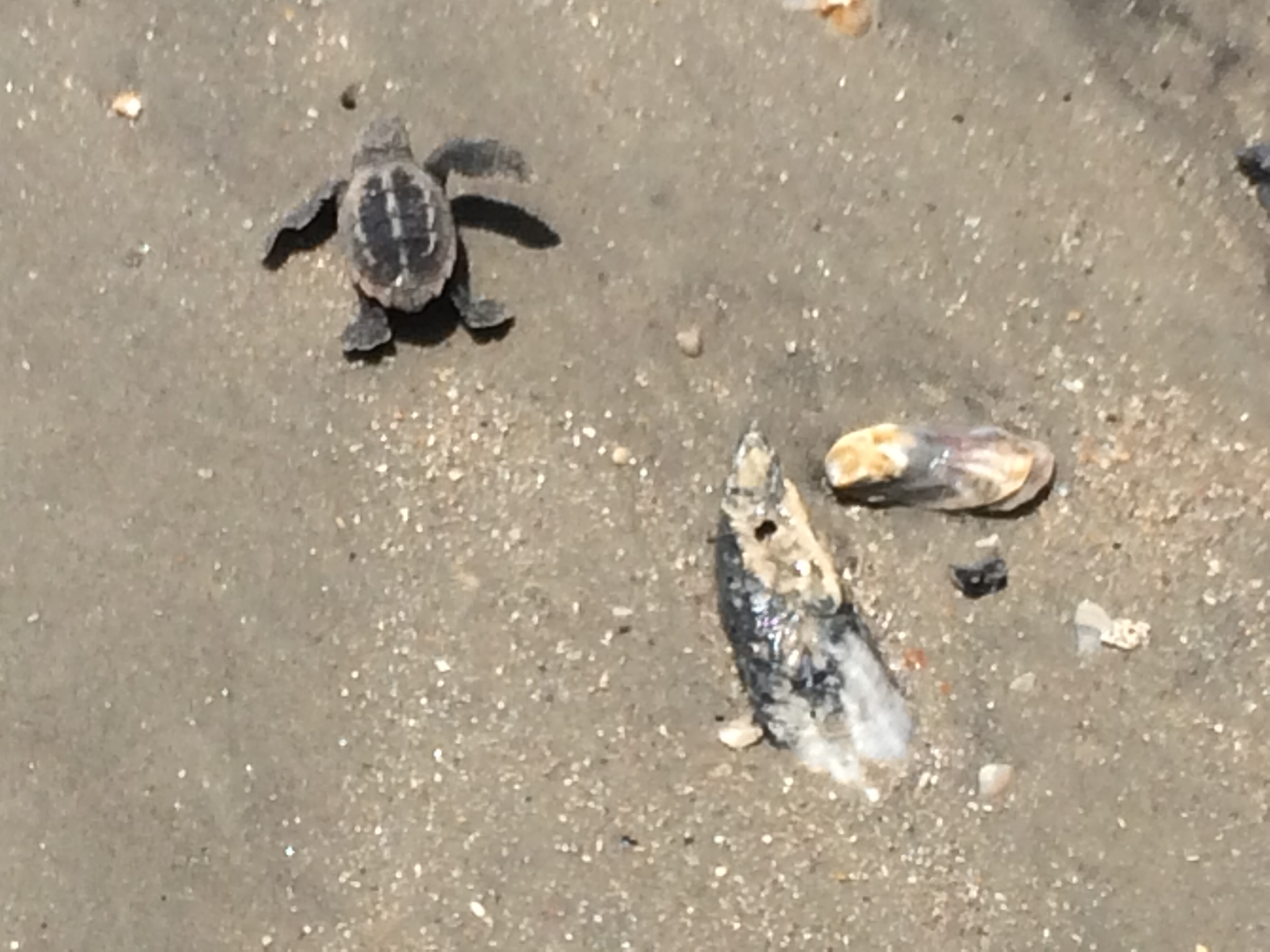
I learned today that only 1 in a thousand or possibly even ten thousand survive into maturity at the ripe old age of thirty years.  As the guide Meredith dug deeper into the relocated nest, I was hoping to see a little baby loggerhead sea turtle in person.  I was not to be disappointed.

Nestled within broken eggs, a dead baby, and multiple unhatched eggs was a tiny baby sea turtle.  We rescued him from the pile of sand heaped on top of him, first by his mother, then by his caretakers.  Meredith grabbed him gently and then let him go in the crushed oyster shells lining the beach.

As he flipped and flopped (like a drunken sailor) over the shells, we surrounded him like the rabid paparazzi who follow celebrities.  Finally, he made it to the surf, flapped away, and embarked on his new adventure in the Atlantic Ocean.

We named him Steamer because of his “little engine that could” attitude.

I say a little prayer that he lives long enough to have children of his own.  I know that he had an impact on my life today.  And on the lives of the many children who I will touch with the lessons learned on this trip.

–Sarah

turtle shells


STEAM Salt Marsh 2014 Day 1: Pine Island Adventure!

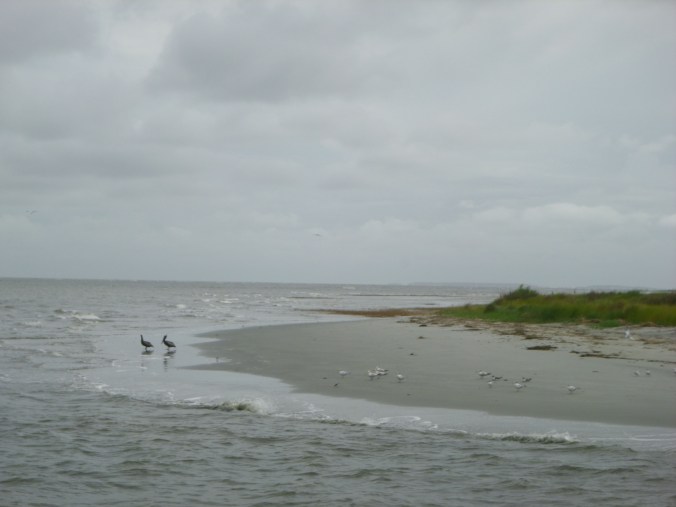
Today, we met at Neptune’s Nest and went on our first adventure as a team to Pine Island, located in the ACE basin.  The ACE basin is a protected estuary about 1.4 million acres in size located at the mouths of the Ashepoo, Cumbahee, and Edisto rivers.   The Discovery vessel from the South Carolina Department of Natural Resources took us to Pine Island and back.  During the trip, they used a trawl net to collect creatures from the water.

In a short amount of time, we caught an iron bed frame along with an Atlantic sharp nose stingray, peppermint shrimp, hogchoker, tongue fish, and spade fish (my son’s favorite fithy!).

This evening, we heard Mary Edna Fraser (of the Frasers who founded Sea Pines Resort) talk about her art advocacy through batiks that depict barrier islands from around the world, as well space photos and deep ocean images.  She stressed the relevance of environmental activism for young  people, and the importance of using art as a visual tool to relate science to the masses.  I was totally inspired to bring this lesson to my students!  As Margaret Mead would say,

“Never doubt that a small group of thoughtful, committed, citizens can change the world. Indeed, it is the only thing that ever has.”
–Sarah