Restoring Kenntnis to Our Children: Alleviating Nature Deficit

Back in 2008, the media and education community responded to the alarm bells of Richard Louv’s seminal work, Last Child in the Woods.  Herein, Mr. Louv observes a new phenomenon in modern society, calling it “nature deficit disorder,” a lack of outdoors experiences for today’s children.

Today, we rarely hear about it anymore, and if we do, school officials ensure us that children are getting more “field trips” and going outdoors for fresh air during physical education and recess.

Even in my children’s and my Montessori classrooms, children get to garden, play outside, go on occasional walks in the forest preserve or to the nearby beach.  I argue that in my nine years as a Montessori teacher, that even isn’t enough.

My own children, three boys, are only truly happy when they are outdoors playing competitive sports and games, or experiencing nature hands-on with fishing, collecting, kayaking, hiking, or photography.

Recently, a doctor prescribed the book Boys Adrift by Dr. Leonard Sax for my reading list.  Her recommendation could not have come sooner.

My middle son wants to be a marine biologist, yet he craves video games like they are alcohol or drugs.  When I pull him off of the games, he is like an addict who can’t stop and will beg, crying for more.  My husband and I have become alarmed.  The other boys are similar in their addictions.

After reading Dr. Sax’s clarion call about the five factors that drive a growing epidemic of unmotivated boys, I felt compelled to make changes in my family life and my classroom, especially in the area of experiential learning.

In the book, Dr. Sax talks about two types of learning described in the German language:  Wissenschaft and Kenntnis.  Wissenschaft can be thought of as book learning, whereas Kenntnis is experiential learning.  Throughout European pedagogy, of which Montessori can be classified, both Wissenschaft and Kenntnis are valuable, but the two types of learning must be balanced.

Too many of us teachers are concerned about getting the curriculum finished by the end of the year and raising test scores.  Even in the Montessori schools, parents want to see progress with hard data, especially at the Middle School level where the next steps are high school and college applications.

However, I have found that the most meaningful learning experiences and knowledge acquisition happen when we go outside and do full-on experiential projects.

Two years ago, my co-teacher and I created a project where the students would study our rectangular, sloping green space upon which we played sports daily, and develop a plan for the Board of Directors to improve the space for school sports, recess, assemblies, and concerts.

The kids broke up into groups based on their natural abilities and passions.  One group who loved math calculations measured and calculated the area of the space for fencing. Another related group calculated the volume of the space to estimate the amount of soil needed to level the area.  Another group became naturalists and identified the species of plants and animals that would be impacted by the changes proposed to the space.  (We are adjacent to a protected tidal marsh.)  Another group researched coverings to shade the area.  The results were amazing and the group presented the findings at the graduation ceremony.  Along the way, they mastered measurement, area and volume calculations, biological identification, and practical life cost analysis.

Recently, we have begun our study of the Hilton Head Island ecosystem using a curriculum developed by the South Carolina Department of Natural Resources and myself at the recent STEAM Salt Marsh 2014 workshop (see my posts).  After receiving a lesson on the gifts of the Animal Kingdom phyla and Chordata classes (a refresher from Upper Elementary), the students and I went on a hunt for an example of each one on Hilton Head to gather photographic evidence for their portfolios.  I taught them the basics of photography and off we went. The students were incredibly motivated.  So far, they have found 25 different species of birds, reptiles, amphibians, worms, insects, arachnids, and mammals.  Next week, we will continue our hunt on the beach.

I love how the children ran all around, looking under logs and in the trees, in the water and in the sky to observe their surroundings with the eyes of a naturalist for the first time.  Giving them the “treasure hunt” format with a hint of competition and letting them loose with their iPods, iPhones, and cameras leads to fevered discussions and discoveries.

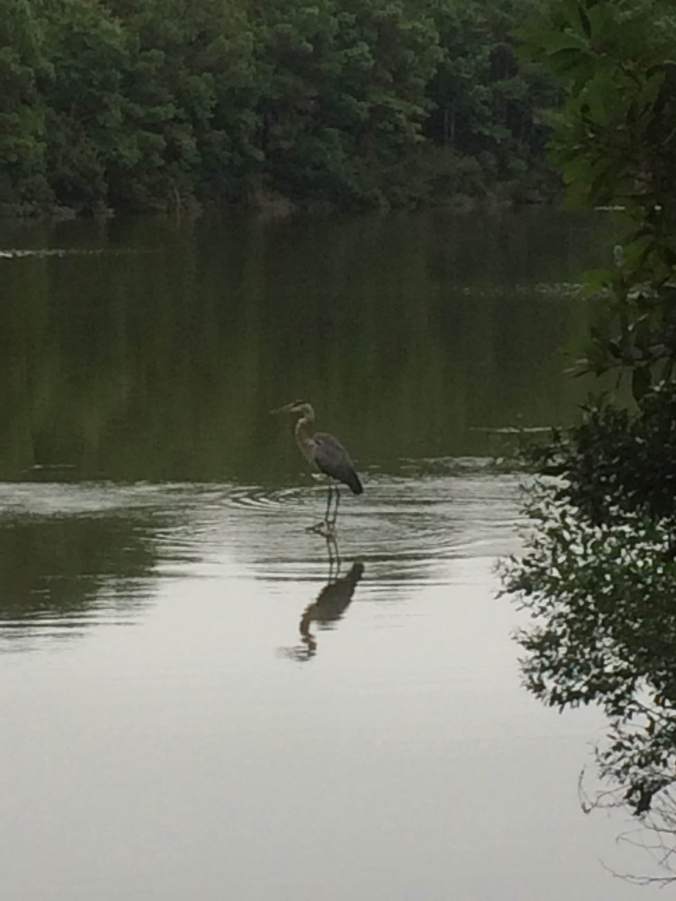
The cover photo comes from 8th grader Corbin McKinney.  I will post more photos once the students have created and shared their portfolios.

Nature needs to be a daily experience.

“The clearest way into the Universe is through a forest wilderness.”
― John Muir

–Sarah
First Week of School: Building Community

In Montessori middle school programs, it is vital to start the year with community building lessons and activities.

“To learn, children and adolescents need to feel safe and supported.” –  William H. Parrett and Kathleen M. Budge

We begin every morning with a fun game to get the students relaxed and energized before academic lessons.  These include name recognition, charades, sports-related/coordination building, and trust-building activities.

Then, we have morning meeting daily.  Each week, a different student facilitates the meeting with a set agenda that includes sharing, acknowledgements, mental challenges, PACE (Brain Gym), and announcements.  The regularity and positive sharing aspects allow the students to communicate in a respectful way and wake up their brains and bodies for learning.

During academic work times, all subject areas involve individual, small group, and large group assignments.  This way, introverted children have some personal time to complete assignments suited to their personality, and extroverted children get their group discussion needs met.  In between, small group work allows children to build leadership and cooperation skills.  Middle school children especially desire more social interaction and learn better from peers than teachers. (see article here)

At Sea Pines Montessori Academy, we are off on the right foot with our class of 2014-2015.  These wonderful young men and women are going to do great things…

–Sarah

Making Lemonade: Remaking Your Classroom Space

With our growing lower school, my middle school program had to move from one large classroom into two smaller spaces at the opposite end of the school.  A larger pre-school program means more children for our upper school.  But, as any teacher will tell you, moving your entire classroom and its contents is no easy task.

On top of that, I had to put two years of curriculum for every subject I teach (language arts; history – world, American, South Carolina; math – Pre-Algebra, Algebra 1 and 2, Geometry; Chinese; science – physical and biological, and practical life) somewhere in that space.  All while leaving room for eight teenagers to move around.  Phew!

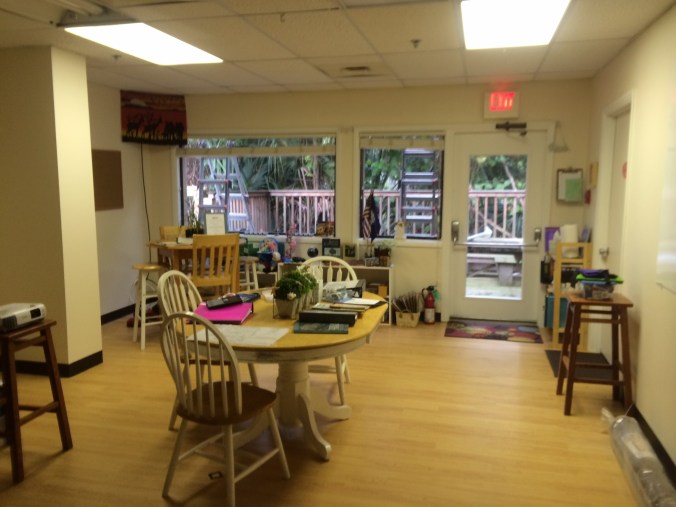
My motto became when life hands you some nice lemons, make lemonade!  I re-imagined the space, and with some help from friends, the local thrift shops, and creativity, succeeded in creating a welcoming environment.

The video below is a slide-show of my classroom and its contents.  As a Montessori Middle School teacher, I am a generalist.  I have a cultural area for history and science.  My language arts and math books are in another room where we have created a library and work space.  This year, we are focusing on biological science and using the Estuary 101 curriculum I received from the South Carolina Department of Natural Resources (see my week-long post from the Salt Marsh STEAM experiences).

I maximized floor space with three small tables, and kept the wood as light as possible to make the space seem larger.  I used natural wood and table decorations to infuse the classroom with vitality and nature.  I kept familiar items (student mementos) so that they would have a continuum from the old space.  I added some inspirational messages for the front door so the teens would feel hopeful as they walked into the room.

Overall, I am pleased with the outcome.  The students and parents who visited last week enjoyed it too.  I look forward to the exciting things we will be doing as we study our beautiful island ecosystem and study global peace through our Model United Nations projects.

Peace, Sarah

Montessori Kids Rock at Math!

American education is under fire again in the news media with the latest set of articles by Elizabeth Green, who works for a non-profit called Chalkbeat (and is plugging a new book).  Her original article asks the question, “Why Do Americans Stink at Math?” and the follow-up article tells us “5 Ways to Help Your Kid Not Stink at Math”.

As a Montessori teacher, I am livid.  My students do not “stink at math.”  Rather, they master the concepts and thrive in high school and college classes.  In fact, my students score as well as college-aged young people (post-high school score level) on nationally recognized standardized tests.  These teens leave middle school with at least a credit for high school level Algebra 1, and most teens leave with credits for Algebra 1 and Geometry Honors.  How?  Montessori math materials and lessons.

Well-known Montessori teacher, trainer, and author Michael Duffy shows how well the Montessori math pedagogy and materials work, through scientific evidence and current brain research in his book, Math Works.  (Math Works by Michael Duffy)

Over the past seven years, I have seen miracles worked through the use of these materials, teaching abstract math concepts with concrete manipulatives.  I currently teach middle school students at Sea Pines Montessori Academy, but have also taught elementary students from ages six to twelve.  (See “About” on my home page.)

What is Montessori?  The curriculum was developed by Dr. Maria Montessori in Italy at the beginning of the twentieth century.  She worked with children with Down’s Syndrome, developing materials to help them to learn basic life, math, and language skills.  These materials worked so well that she begged the Italian government to try her method with children who did not have severe learning differences.

Dr. Montessori settled for a group of poor, neglected children in a tenement building in Rome.  History was made.  She turned unruly, uneducated children born into poverty into productive, self-motivated learners who were able to read by the age of four and five, and do complex math computations. (See Maria Montessori:  A Biography by Rita Kramer.)

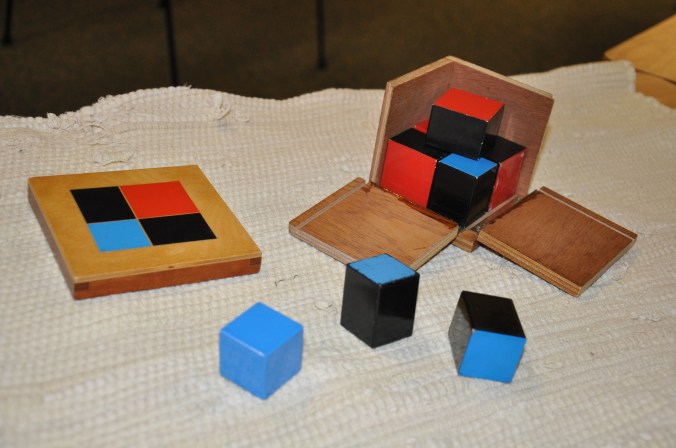
What are these special materials?  Traditional educators like to call them “manipulatives.”  Montessori materials are just concrete representations of math concepts like place value, numeration, value, quantity, area, volume, operations, and so forth.

For instance, she uses the colors green, blue, and red to represent the units (or ones), tens, and hundreds place values, respectively.  Children learn the correct place value in numbers, fractions, and decimals through the use of these symbolic colors in “building” numbers by gathering a quantity of beads, wooden blocks, or counters in a certain color and matching the quantity to the name or value we give it, like 1,435.

The power of the symbolic colors and actual quantity of beads for a number is that children use these counters/beads to perform operations like addition, subtraction, multiplication, and division.  They truly see that multiplication is serial addition.  The children learn that division of a number involves evenly dividing the dividend among the divisor, and the answer to division is always what one “person” gets.

The children carry these mental pictures of operations for the rest of their lives.  Dr. Montessori, along with her son, developed materials to represent algebraic concepts and geometric proofs.  In an interview with Montessori high school students at School of the Woods, in Houston, Texas (one of the few Montessori high schools in the country), life-long Montessori kids told me that they still think of the materials when doing complex calculus.  These mental images help them solve integrals (used to calculate area and volume).

When I read such articles as Elizabeth Green’s, and how the Japanese have found a “new way” to approach math, with the development of understanding of a concept, not just rote memorization, and how they help train teachers to give and perfect those lessons with peer observations, and that the teacher, above all, must reflect on what it means to be teacher, I just want to scream!!!

Dr. Montessori and her legions of disciples have been using and making materials for over one hundred years.  To be a Montessori teacher, you need at least two years of training on pedagogy, child development, and materials use, design, and implementation.  You also have peer and administrator observations to earn your credential.  Finally, Dr. Montessori wrote that the teacher must spiritually prepare himself or herself to properly prepare the educational environment and help the child learn through activity.

I will leave you with some quotes from Dr. Montessori made over sixty years ago, with some made almost a hundred years ago.  American educators and educational administrators need to get their heads out of their butts and go observe a successful Montessori school.  You will see children who rock at math. You will also see what needs to happen in American education to make our children successful in life:  academic mastery with meaningful social and emotional support in a caring community of self-motivated learners.

“If education is always to be conceived along the same antiquated lines of a mere transmission of knowledge, there is little to be hoped from it in the bettering of man’s future. For what is the use of transmitting knowledge if the individual’s total development lags behind?” Maria Montessori, unknown
The senses, being explorers of the world, open the way to knowledge. Our apparatus for educating the senses offers the child a key to guide his explorations of the world…”  Montessori, M. (1988). The Absorbent Mind. Oxford: Clio Press. p. 167
“Here is an essential principal of education: to teach details is to bring confusion; to establish the relationship between things is to bring knowledge.” Maria Montessori, From Childhood to Adolescence
“The vision of the teacher should be at once precise like that of the scientist, and spiritual like that of the saint. The preparation for science and the preparation for sanctity should form a new soul, for the attitude of the teacher should be at once positive, scientific and spiritual.
Positive and scientific, because she has an exact task to perform, and it is necessary that she should put herself into immediate relation with the truth by means of rigorous observation…
Spiritual, because it is to man that his powers of observation are to be applied, and because the characteristics of the creature who is to be his particular subject of observation are spiritual.” (Dr. Maria Montessori, ‘The Advanced Montessori Method – I’, Clio Press Ltd, 107)