Making Lemonade: Remaking Your Classroom Space

With our growing lower school, my middle school program had to move from one large classroom into two smaller spaces at the opposite end of the school.  A larger pre-school program means more children for our upper school.  But, as any teacher will tell you, moving your entire classroom and its contents is no easy task.

On top of that, I had to put two years of curriculum for every subject I teach (language arts; history – world, American, South Carolina; math – Pre-Algebra, Algebra 1 and 2, Geometry; Chinese; science – physical and biological, and practical life) somewhere in that space.  All while leaving room for eight teenagers to move around.  Phew!

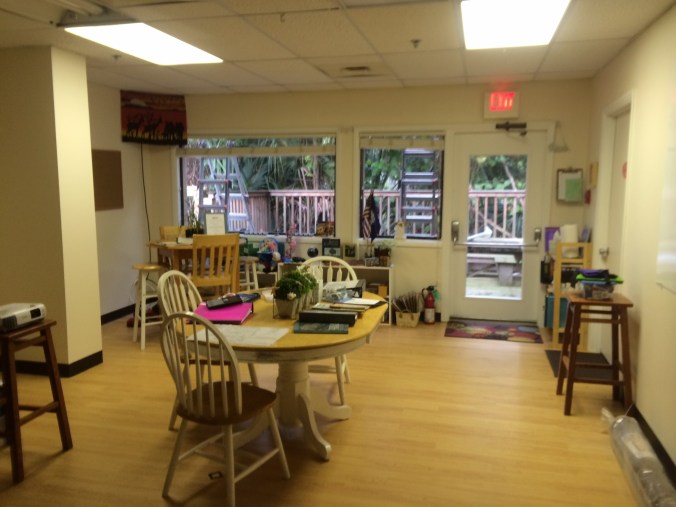
My motto became when life hands you some nice lemons, make lemonade!  I re-imagined the space, and with some help from friends, the local thrift shops, and creativity, succeeded in creating a welcoming environment.

The video below is a slide-show of my classroom and its contents.  As a Montessori Middle School teacher, I am a generalist.  I have a cultural area for history and science.  My language arts and math books are in another room where we have created a library and work space.  This year, we are focusing on biological science and using the Estuary 101 curriculum I received from the South Carolina Department of Natural Resources (see my week-long post from the Salt Marsh STEAM experiences).

I maximized floor space with three small tables, and kept the wood as light as possible to make the space seem larger.  I used natural wood and table decorations to infuse the classroom with vitality and nature.  I kept familiar items (student mementos) so that they would have a continuum from the old space.  I added some inspirational messages for the front door so the teens would feel hopeful as they walked into the room.

Overall, I am pleased with the outcome.  The students and parents who visited last week enjoyed it too.  I look forward to the exciting things we will be doing as we study our beautiful island ecosystem and study global peace through our Model United Nations projects.

Peace, Sarah
Salt Marsh STEAM 2014 Day 5: Inspiring Project Presentations


We have come to the end of the Salt Marsh STEAM program with South Carolina’s Department of Natural Resources, Salt Marsh Consortium, Sea Grant, NOAA, Bobino (did I leave anyone out?).  E.V. Bell and her co-workers put together an amazing week of learning, fun, community, and swag.  Thank you all!

Today, each participating teacher presented his/her proposal for a project based on the Estuaries 101 curriculum and activities that we learned this week involving science, technology, engineering, art, and math (STEAM).  I learned so many different, creative approaches to educating children about these ecosystems.

We had edible marshlands, iMovies, Bobinos (Arduino-based buoys), watercolors, poems and more.  An English teacher teaching literature archetypes created a project where students would research animals and plants in the estuary and match that fauna or flora to a certain literary archetype.  Students would then compose an origin myth about that particular organism and archetype.  Another is having her students build a Bobino from PVC tubing and connectors and then monitor weather and water quality around Hilton Head Island.

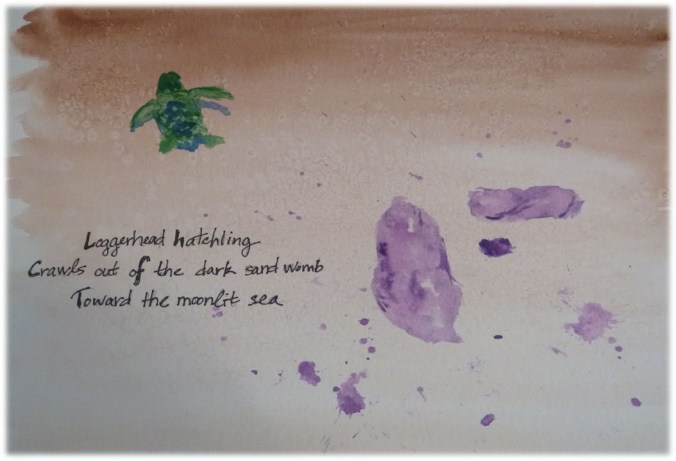
I will be using the Estuaries 101 curriculum to teach biology units all throughout this year.  My particular presentation is on a poetry anthology that the students will complete based on the flora and fauna of the ACE basin and Hilton Head.  The theme for the six-week cycle is systems, where we will study economies, systems of equations in algebra, ecosystems, and “systematic” poetry.  Students will write a haiku, Shakespearean sonnet, ode, and sestina; all of these poetry types require the writer to use certain rules for topic, syllable count, meter, rhyme, and word count.

Then, students will create watercolors, photographs, or movies to illustrate their poetry.  Finally, the teens will be required to write an essay where they explain their choice of topic and how that poetic structure fits with their topic.  The anthologies will be compiled with cover page and presented.

I have enclosed a video slideshow to display my examples and SC state standards met by this activity.

Thank you STEAM friends.  I had a lot of fun.  Remember, Neptune’s Nest foreva!

–Sarah