Back in 2008, the media and education community responded to the alarm bells of Richard Louv’s seminal work, Last Child in the Woods. Herein, Mr. Louv observes a new phenomenon in modern society, calling it “nature deficit disorder,” a lack of outdoors experiences for today’s children.
Today, we rarely hear about it anymore, and if we do, school officials ensure us that children are getting more “field trips” and going outdoors for fresh air during physical education and recess.
Even in my children’s and my Montessori classrooms, children get to garden, play outside, go on occasional walks in the forest preserve or to the nearby beach. I argue that in my nine years as a Montessori teacher, that even isn’t enough.
My own children, three boys, are only truly happy when they are outdoors playing competitive sports and games, or experiencing nature hands-on with fishing, collecting, kayaking, hiking, or photography.
Recently, a doctor prescribed the book Boys Adrift by Dr. Leonard Sax for my reading list. Her recommendation could not have come sooner.
My middle son wants to be a marine biologist, yet he craves video games like they are alcohol or drugs. When I pull him off of the games, he is like an addict who can’t stop and will beg, crying for more. My husband and I have become alarmed. The other boys are similar in their addictions.
After reading Dr. Sax’s clarion call about the five factors that drive a growing epidemic of unmotivated boys, I felt compelled to make changes in my family life and my classroom, especially in the area of experiential learning.
In the book, Dr. Sax talks about two types of learning described in the German language: Wissenschaft and Kenntnis. Wissenschaft can be thought of as book learning, whereas Kenntnis is experiential learning. Throughout European pedagogy, of which Montessori can be classified, both Wissenschaft and Kenntnis are valuable, but the two types of learning must be balanced.
Too many of us teachers are concerned about getting the curriculum finished by the end of the year and raising test scores. Even in the Montessori schools, parents want to see progress with hard data, especially at the Middle School level where the next steps are high school and college applications.
However, I have found that the most meaningful learning experiences and knowledge acquisition happen when we go outside and do full-on experiential projects.
Two years ago, my co-teacher and I created a project where the students would study our rectangular, sloping green space upon which we played sports daily, and develop a plan for the Board of Directors to improve the space for school sports, recess, assemblies, and concerts.
The kids broke up into groups based on their natural abilities and passions. One group who loved math calculations measured and calculated the area of the space for fencing. Another related group calculated the volume of the space to estimate the amount of soil needed to level the area. Another group became naturalists and identified the species of plants and animals that would be impacted by the changes proposed to the space. (We are adjacent to a protected tidal marsh.) Another group researched coverings to shade the area. The results were amazing and the group presented the findings at the graduation ceremony. Along the way, they mastered measurement, area and volume calculations, biological identification, and practical life cost analysis.
Recently, we have begun our study of the Hilton Head Island ecosystem using a curriculum developed by the South Carolina Department of Natural Resources and myself at the recent STEAM Salt Marsh 2014 workshop (see my posts). After receiving a lesson on the gifts of the Animal Kingdom phyla and Chordata classes (a refresher from Upper Elementary), the students and I went on a hunt for an example of each one on Hilton Head to gather photographic evidence for their portfolios. I taught them the basics of photography and off we went. The students were incredibly motivated. So far, they have found 25 different species of birds, reptiles, amphibians, worms, insects, arachnids, and mammals. Next week, we will continue our hunt on the beach.
I love how the children ran all around, looking under logs and in the trees, in the water and in the sky to observe their surroundings with the eyes of a naturalist for the first time. Giving them the “treasure hunt” format with a hint of competition and letting them loose with their iPods, iPhones, and cameras leads to fevered discussions and discoveries.
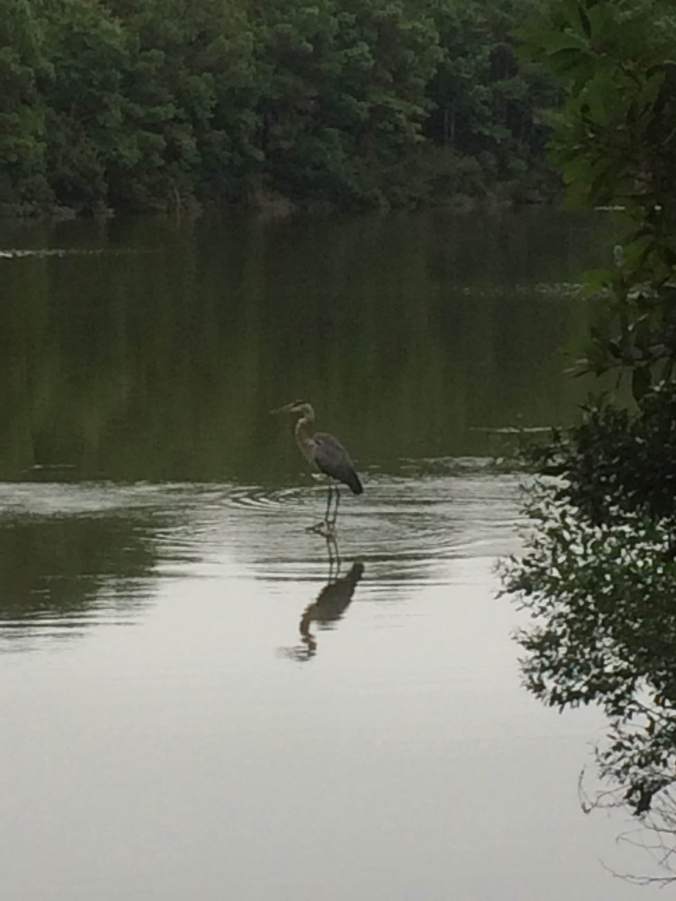
The cover photo comes from 8th grader Corbin McKinney. I will post more photos once the students have created and shared their portfolios.
Nature needs to be a daily experience.
“The clearest way into the Universe is through a forest wilderness.”
― John Muir
–Sarah
 Sarah W Baird: Montessori Musings