Restoring Kenntnis to Our Children: Alleviating Nature Deficit

Back in 2008, the media and education community responded to the alarm bells of Richard Louv’s seminal work, Last Child in the Woods.  Herein, Mr. Louv observes a new phenomenon in modern society, calling it “nature deficit disorder,” a lack of outdoors experiences for today’s children.

Today, we rarely hear about it anymore, and if we do, school officials ensure us that children are getting more “field trips” and going outdoors for fresh air during physical education and recess.

Even in my children’s and my Montessori classrooms, children get to garden, play outside, go on occasional walks in the forest preserve or to the nearby beach.  I argue that in my nine years as a Montessori teacher, that even isn’t enough.

My own children, three boys, are only truly happy when they are outdoors playing competitive sports and games, or experiencing nature hands-on with fishing, collecting, kayaking, hiking, or photography.

Recently, a doctor prescribed the book Boys Adrift by Dr. Leonard Sax for my reading list.  Her recommendation could not have come sooner.

My middle son wants to be a marine biologist, yet he craves video games like they are alcohol or drugs.  When I pull him off of the games, he is like an addict who can’t stop and will beg, crying for more.  My husband and I have become alarmed.  The other boys are similar in their addictions.

After reading Dr. Sax’s clarion call about the five factors that drive a growing epidemic of unmotivated boys, I felt compelled to make changes in my family life and my classroom, especially in the area of experiential learning.

In the book, Dr. Sax talks about two types of learning described in the German language:  Wissenschaft and Kenntnis.  Wissenschaft can be thought of as book learning, whereas Kenntnis is experiential learning.  Throughout European pedagogy, of which Montessori can be classified, both Wissenschaft and Kenntnis are valuable, but the two types of learning must be balanced.

Too many of us teachers are concerned about getting the curriculum finished by the end of the year and raising test scores.  Even in the Montessori schools, parents want to see progress with hard data, especially at the Middle School level where the next steps are high school and college applications.

However, I have found that the most meaningful learning experiences and knowledge acquisition happen when we go outside and do full-on experiential projects.

Two years ago, my co-teacher and I created a project where the students would study our rectangular, sloping green space upon which we played sports daily, and develop a plan for the Board of Directors to improve the space for school sports, recess, assemblies, and concerts.

The kids broke up into groups based on their natural abilities and passions.  One group who loved math calculations measured and calculated the area of the space for fencing. Another related group calculated the volume of the space to estimate the amount of soil needed to level the area.  Another group became naturalists and identified the species of plants and animals that would be impacted by the changes proposed to the space.  (We are adjacent to a protected tidal marsh.)  Another group researched coverings to shade the area.  The results were amazing and the group presented the findings at the graduation ceremony.  Along the way, they mastered measurement, area and volume calculations, biological identification, and practical life cost analysis.

Recently, we have begun our study of the Hilton Head Island ecosystem using a curriculum developed by the South Carolina Department of Natural Resources and myself at the recent STEAM Salt Marsh 2014 workshop (see my posts).  After receiving a lesson on the gifts of the Animal Kingdom phyla and Chordata classes (a refresher from Upper Elementary), the students and I went on a hunt for an example of each one on Hilton Head to gather photographic evidence for their portfolios.  I taught them the basics of photography and off we went. The students were incredibly motivated.  So far, they have found 25 different species of birds, reptiles, amphibians, worms, insects, arachnids, and mammals.  Next week, we will continue our hunt on the beach.

I love how the children ran all around, looking under logs and in the trees, in the water and in the sky to observe their surroundings with the eyes of a naturalist for the first time.  Giving them the “treasure hunt” format with a hint of competition and letting them loose with their iPods, iPhones, and cameras leads to fevered discussions and discoveries.

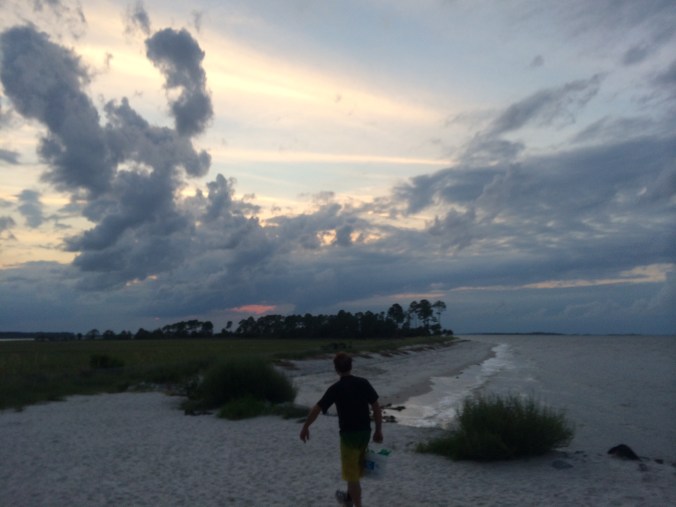
The cover photo comes from 8th grader Corbin McKinney.  I will post more photos once the students have created and shared their portfolios.

Nature needs to be a daily experience.

“The clearest way into the Universe is through a forest wilderness.”
― John Muir

–Sarah
Salt Marsh STEAM 2014 Day 5: Inspiring Project Presentations


We have come to the end of the Salt Marsh STEAM program with South Carolina’s Department of Natural Resources, Salt Marsh Consortium, Sea Grant, NOAA, Bobino (did I leave anyone out?).  E.V. Bell and her co-workers put together an amazing week of learning, fun, community, and swag.  Thank you all!

Today, each participating teacher presented his/her proposal for a project based on the Estuaries 101 curriculum and activities that we learned this week involving science, technology, engineering, art, and math (STEAM).  I learned so many different, creative approaches to educating children about these ecosystems.

We had edible marshlands, iMovies, Bobinos (Arduino-based buoys), watercolors, poems and more.  An English teacher teaching literature archetypes created a project where students would research animals and plants in the estuary and match that fauna or flora to a certain literary archetype.  Students would then compose an origin myth about that particular organism and archetype.  Another is having her students build a Bobino from PVC tubing and connectors and then monitor weather and water quality around Hilton Head Island.

I will be using the Estuaries 101 curriculum to teach biology units all throughout this year.  My particular presentation is on a poetry anthology that the students will complete based on the flora and fauna of the ACE basin and Hilton Head.  The theme for the six-week cycle is systems, where we will study economies, systems of equations in algebra, ecosystems, and “systematic” poetry.  Students will write a haiku, Shakespearean sonnet, ode, and sestina; all of these poetry types require the writer to use certain rules for topic, syllable count, meter, rhyme, and word count.

Then, students will create watercolors, photographs, or movies to illustrate their poetry.  Finally, the teens will be required to write an essay where they explain their choice of topic and how that poetic structure fits with their topic.  The anthologies will be compiled with cover page and presented.

I have enclosed a video slideshow to display my examples and SC state standards met by this activity.

Thank you STEAM friends.  I had a lot of fun.  Remember, Neptune’s Nest foreva!

–Sarah


Salt Marsh STEAM 2014 Day 4: Geekin’ Out!

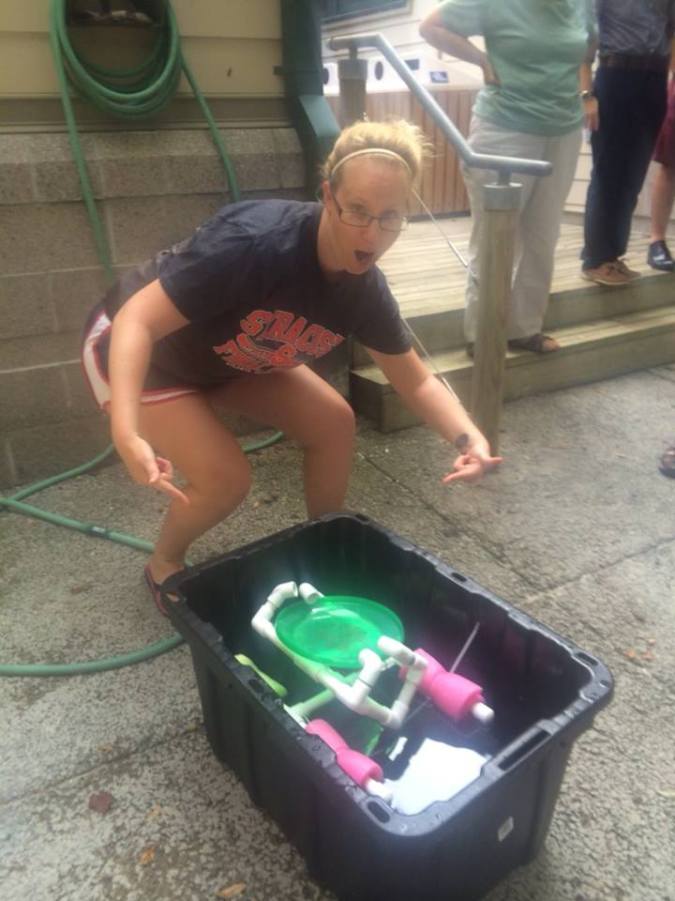
Today was a TOTAL blast.  We got to find our inner geek (or use our outer one) and engineer buoys. Buoys play an important role in monitoring the environment and providing data to find trends in ecosystems.

The instructors proved a great maker space of different sizes of PVC pipe and connectors along with swimming noodles.  Our goal was to create a buoy that would float upright and keep a frisbee still to prop up an Arduino board.  The Arduino board contained sensors to measure air temperature, ambient light, barometric pressure, and humidity.

Once we tested the buoy for buoyancy, we added the Arduino weather monitor.  Our “eBOB” or “Bobino” collected data every minute for 30 minutes.  Some groups kept their eBobs inside, while others placed theirs outside.

Then, we analyzed the data using the information stored on the enclosed SD card.  WOW!  Using Excel, we graphed the data and saw neat patterns:  a rise in temperature once the unit was placed outside, correlating with a rise in ambient light.

The gentlemen who provided the equipment, free of charge to us teachers, were part of the North Carolina School of Technology.  Taylor Brockman, Chief Technology Officer at Brain Power Software, helped two young men create the Arduino boards.  These young men, Benson and Maxwell, were polite, intelligent, and inspiring.  (I asked for the leader’s business card to seek out opportunities for my son.)

Jen, my partner in crime, and I had so much fun and were proud to be first to finish our sea turtle inspired buoy.  Peace out!

–Sarah


Salt Marsh STEAM Day 3: Watercolor 101: Marie Nichols is amazing!

I had a two-hour workshop today on sketching and watercolor techniques with Marie Nichols, an instructor at Charleston School of the Arts.  She is an amazing lady with a kind, gentle approach to visual arts.

We started with blind contour drawings of shells and hands.  Let’s just say, my drawings were pretty messed up!  Then, we worked our way to a modified contour drawing where we could take peaks at our paper to follow the prominent lines in the object as we drew.  Finally, we concluded our drawing study with adding value to the modified contour drawing.  Hatching and cross-hatching, with shading added texture, shadows, and depth to our shells.

After our sketching lessons, we learned watercolor techniques.  Starting with a flat wash, we used a broad brush dipped in rather concentrated dark color and brushed it straight across the page.  We repeated these steps, covering our 140 lb. watercolor paper in one, even hue.

We contrasted the flat wash with a graded wash, where you dip the brush only once in the concentrated, dark pigment (in our example), and then brush across the top of the paper.  Then, we washed the brush the clean, dabbed in water and ran the brush partly across the dark brushstroke at the top to get a lighter value.  After each stroke, we dabbed our brush in water and voila, we had a graded background on our paper.

Other techniques included the use of salt, plastic wrap, and lifting to get different textures on the background wash.  We used drops of alcohol to achieve beautiful, round lighter spots on the paper.  Another technique involved wetting the paper first, then applying watercolor on vertical paper to get interesting secondary and tertiary colors from primary hues.  Finally, we splattered paint on the surface, then used a straw to get streaks.

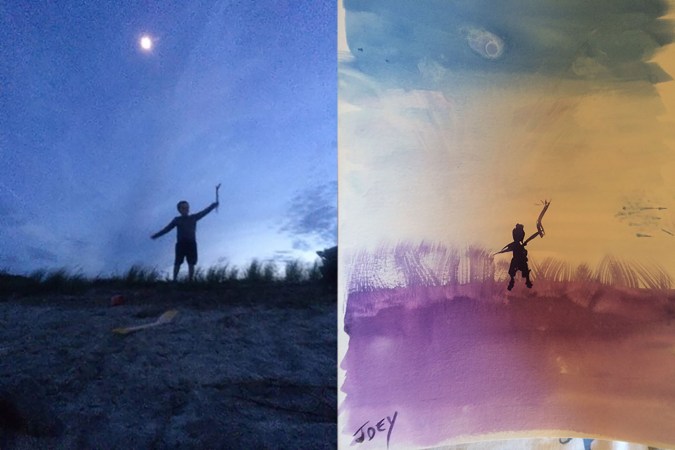
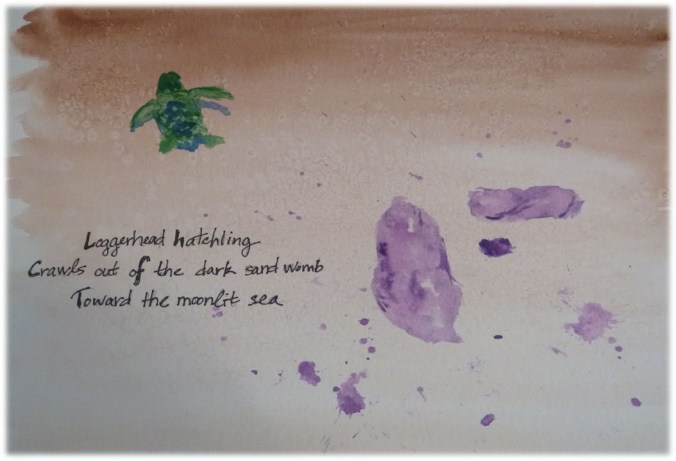
After all of that work, we composed quick pieces of nature scenes using all of our new-found knowledge.  You see mine at the top…an ode to my youngest son, Joey.

–Sarah

Salt Marsh STEAM 2014 Day 2: Saving a Life

Words cannot express what we did today at Botany Bay beach, on Edisto Island.  I have always seen sea turtle nests on Hilton Head Island, marked by wooden posts and signs alerting the public to stay away.  I knew they emerged from their nests at night to follow the moonlight into the ocean, where they swam to an unknown future.

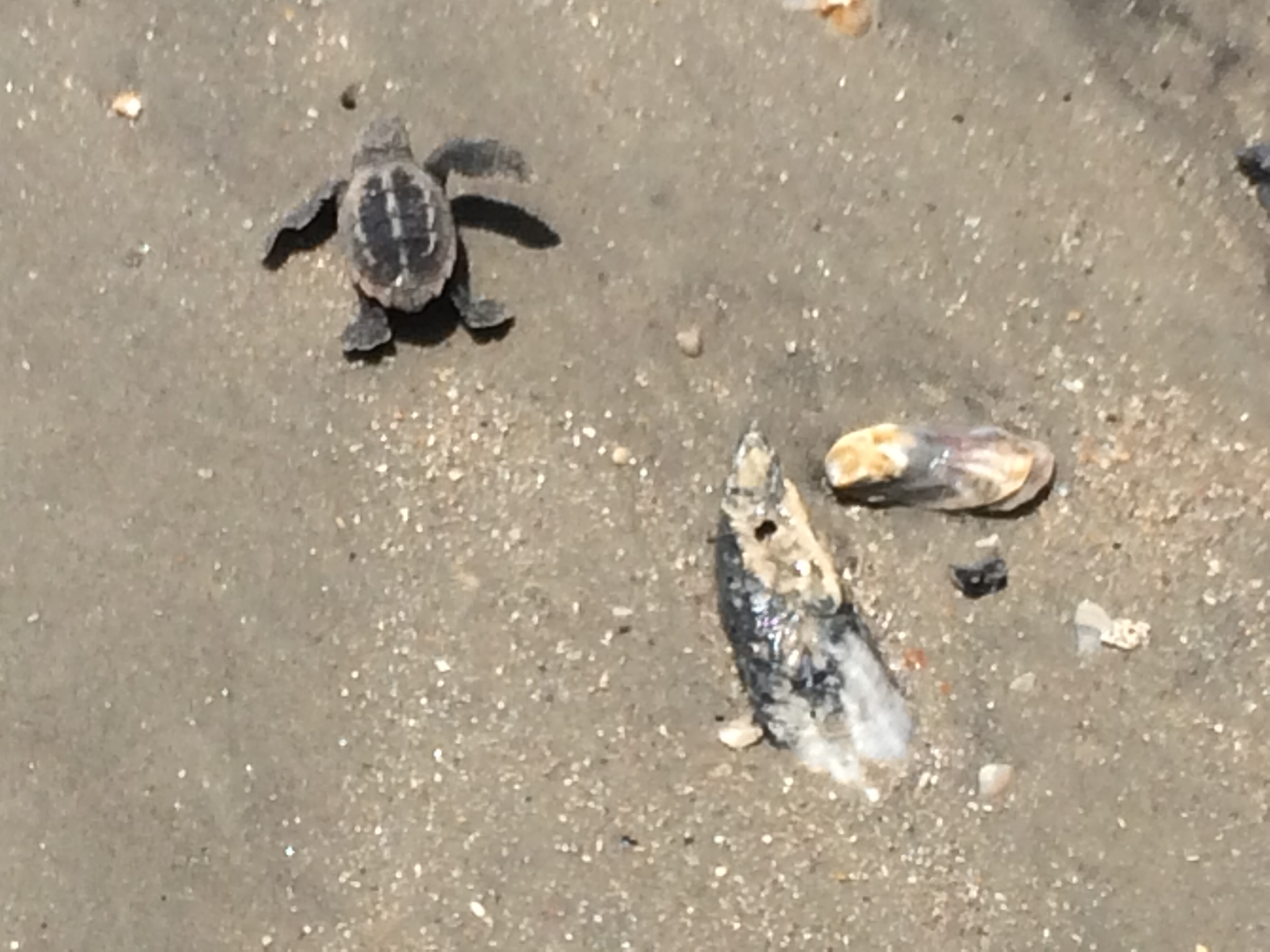
I learned today that only 1 in a thousand or possibly even ten thousand survive into maturity at the ripe old age of thirty years.  As the guide Meredith dug deeper into the relocated nest, I was hoping to see a little baby loggerhead sea turtle in person.  I was not to be disappointed.

Nestled within broken eggs, a dead baby, and multiple unhatched eggs was a tiny baby sea turtle.  We rescued him from the pile of sand heaped on top of him, first by his mother, then by his caretakers.  Meredith grabbed him gently and then let him go in the crushed oyster shells lining the beach.

As he flipped and flopped (like a drunken sailor) over the shells, we surrounded him like the rabid paparazzi who follow celebrities.  Finally, he made it to the surf, flapped away, and embarked on his new adventure in the Atlantic Ocean.

We named him Steamer because of his “little engine that could” attitude.

I say a little prayer that he lives long enough to have children of his own.  I know that he had an impact on my life today.  And on the lives of the many children who I will touch with the lessons learned on this trip.

–Sarah

turtle shells


STEAM Salt Marsh 2014 Day 1: Pine Island Adventure!

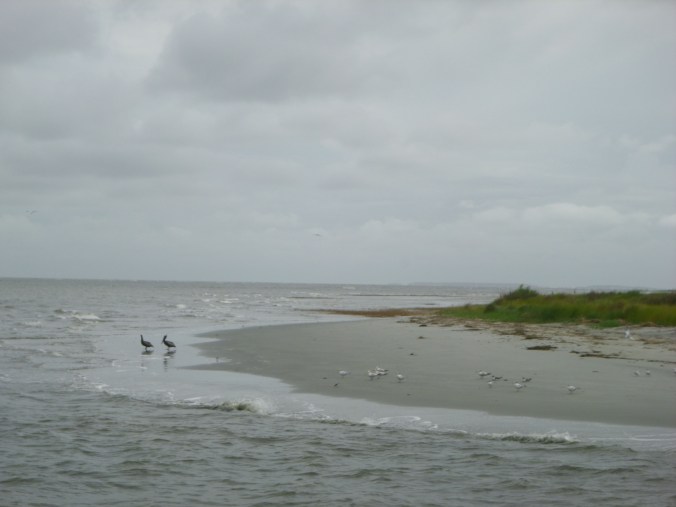
Today, we met at Neptune’s Nest and went on our first adventure as a team to Pine Island, located in the ACE basin.  The ACE basin is a protected estuary about 1.4 million acres in size located at the mouths of the Ashepoo, Cumbahee, and Edisto rivers.   The Discovery vessel from the South Carolina Department of Natural Resources took us to Pine Island and back.  During the trip, they used a trawl net to collect creatures from the water.

In a short amount of time, we caught an iron bed frame along with an Atlantic sharp nose stingray, peppermint shrimp, hogchoker, tongue fish, and spade fish (my son’s favorite fithy!).

This evening, we heard Mary Edna Fraser (of the Frasers who founded Sea Pines Resort) talk about her art advocacy through batiks that depict barrier islands from around the world, as well space photos and deep ocean images.  She stressed the relevance of environmental activism for young  people, and the importance of using art as a visual tool to relate science to the masses.  I was totally inspired to bring this lesson to my students!  As Margaret Mead would say,

“Never doubt that a small group of thoughtful, committed, citizens can change the world. Indeed, it is the only thing that ever has.”
–Sarah

STEAM Salt Marsh 2014: Kayaking for a Cause

I am so excited for next week.  Through the Salt Marsh Consortium and Sea Grant (NOAA) programs, I get to go to Edisto Island and study the ACE basin estuary system.  Marine biologists, alongside artists and writers, will help teachers from around the state turn STEM lessons (Science, Technology, Engineering, and Mathematics) into STEAM (adding art to the mix).  We get to learn photography, sketching, watercolors, creative writing, and marine biology.

I will add posts daily to let you all learn about the wildlife and the art techniques I will experience every day.

Join me starting August 4th!